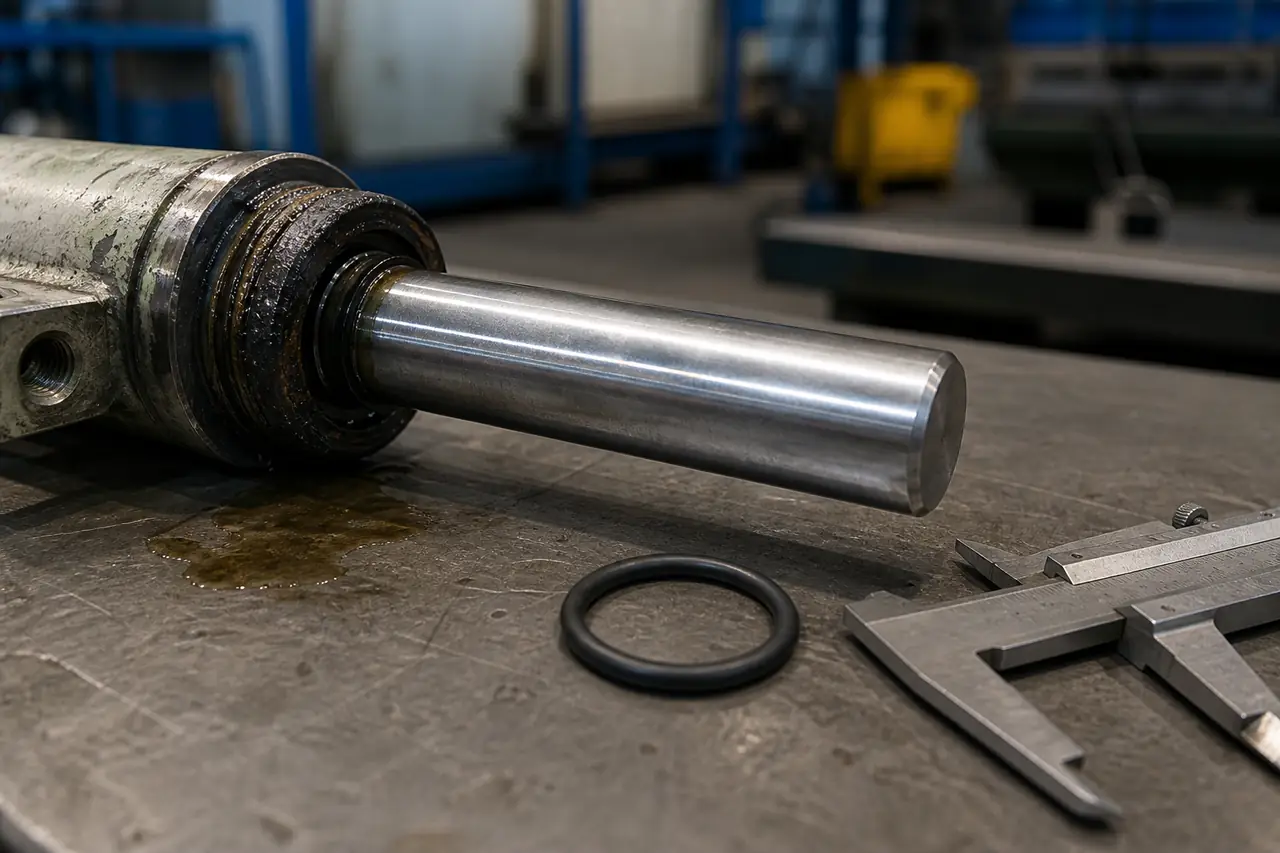
A leaking seal is rarely random. It is usually geometry, compound and duty cycle together. These are the seven causes we most often see on samples from plants in Uzbekistan.
Working-lip wear. A score on the rod or shaft cuts the lip; oil leaves as a thin film. If the shaft is already damaged, a new seal will not last: restore the surface or use a repair size first.
Wrong compound for the medium. NBR hardens on hot steam or solvents. EPDM swells in mineral oil. Viton costs more but holds hydrocarbons and heat. Without the medium named, guesswork almost always fails.
Wrong hardness. A soft mix extrudes into the gap under pressure; a hard mix will not seat. Hydraulics often use Shore A 70–90; static gaskets 50–70. We confirm against drawing and pressure.
Misalignment, oval housing, burrs on the chamfer. An accurate ring still leaks if the groove is damaged. On a worn sample we record seating marks, not only the section.
Dry running at start-up. An oil-seal lip without a film burns in minutes. That is duty, not a mixing defect. Note pre-lubrication and idle time in the request.
Pressure or temperature peaks beyond the compound rating. Regular spikes call for a backup ring or a different profile — not a tighter fit.
Ageing in storage. Ozone, sun and heat ruin a part before fitment. Surface cracks on bending are typical. Store rubber parts closed, away from light.
Send a leak photo, the worn part or drawing, medium, temperature, pressure and shaft speed if it rotates. Standard lead time is 3–5 business days after approval; a new mold is usually 10–14 days.
An ELASTIK FORM engineer matches profile and grade to the actual assembly. WhatsApp / phone: +998 90 944 99 40.