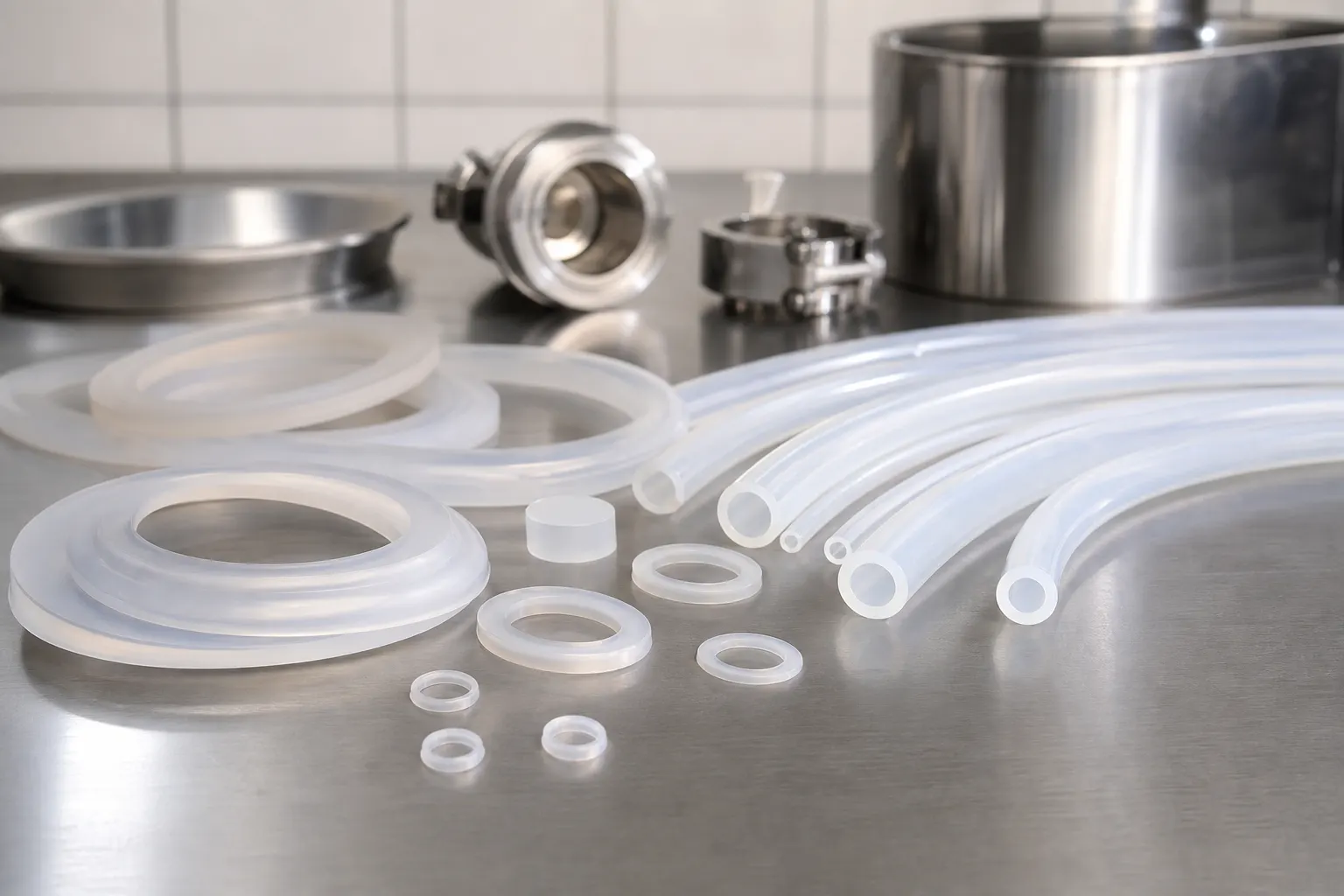
Silicone shines in food, medical and high-temperature uses — but it is not universal.
Pros: about −60…+250°C, cold flexibility, inertness, food-grade options, ozone/UV resistance.
Cons: weaker against oils/hydrocarbons, lower tear strength than NBR/PU, higher raw cost.
Choose silicone for food equipment, oven seals, heat gaskets, medical parts.
Prefer NBR for hydraulics, oil and fuel. For water/steam without oil, EPDM is often better.
We mold silicone parts to drawing or sample — send operating conditions for advice.
Silicone is chosen for temperature and inertness, not tear strength. In abrasion and on a dynamic oil lip it usually loses to NBR and PU.
Food contact is papers, not transparency.
CIP and steam are agreed separately: not every silicone survives wash alkali. A filler may be silicone while the gearbox next to it stays NBR.
State temperature, food contact and motion. After approval, typically 3–5 business days.