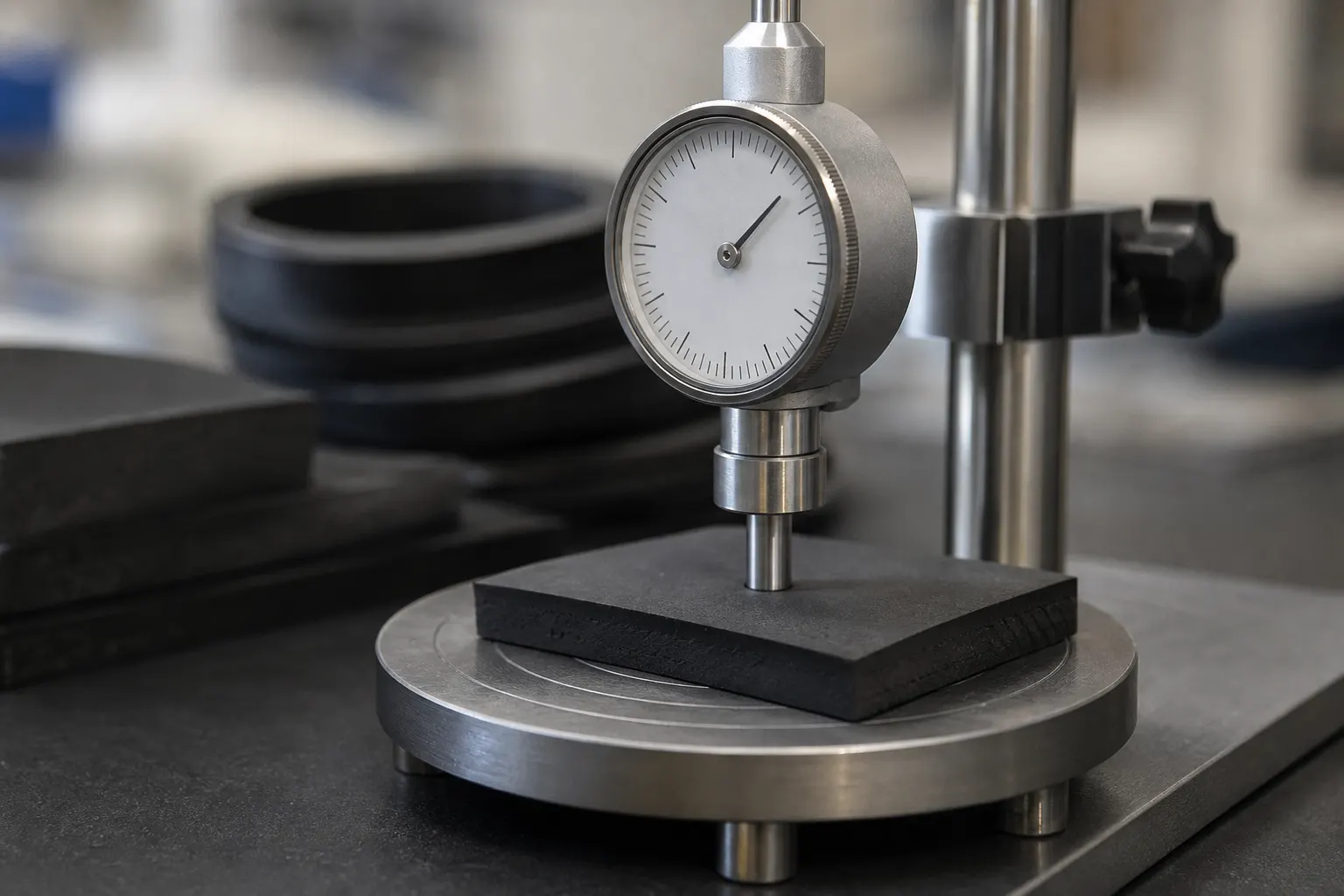
Shore A is hardness, not quality — it affects sealing and extrusion resistance.
40–50: soft, seals uneven surfaces, extrudes easier under pressure.
60–75: typical for O-rings and cups (often 70±5).
80–90: high pressure/wear; less forgiving on fit errors.
Do not confuse Shore A with Shore D used for hard plastics/PU.
Unknown hardness — we measure with a durometer and match an analog.
Shore A is measured on a thick enough slab or part. A thin cuff lip lies. Batch control agrees the test point.
50–60 soft lids and cords, 70 common rings, 80–90 hydraulics. Guides, not dogma: gap and squeeze matter more.
One NBR grade exists in several hardnesses. Mixing 70 and 90 in one groove is a classic failure.
State a hardness or send a sample rather than “a bit harder”.